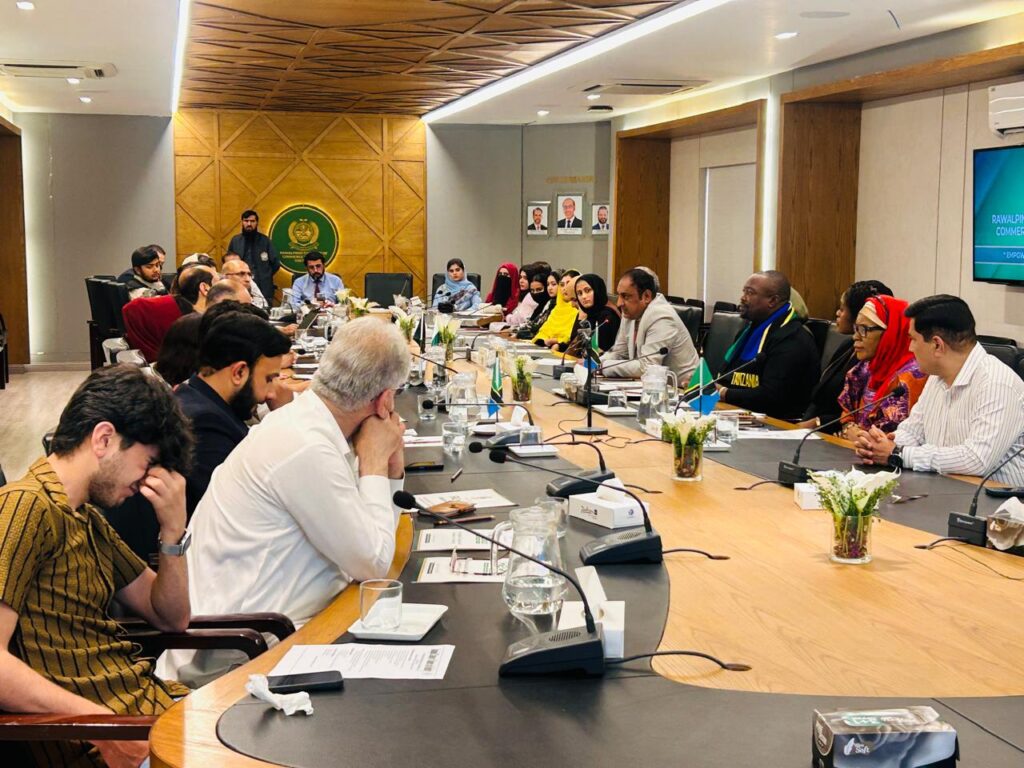
Organiser: Institute of International Peace Leaders (IIPL) · Venue: Rawalpindi Chamber of Commerce and Industry Collaborating Partners: Prime Minister’s Youth Programme · Rawalpindi Chamber of Commerce and Industry (RCCI) · International Delegates from Tanzania (Martina Kabisama & Gaston Francis) Speakers/ Facilitators: Hira A. Siddiqi, Mgeni Kabisama
Background
The Institute of International Peace Leaders (IIPL), chaired by Muhammad Atta Ur Rehman, organised a session on Peace Leadership and Conflict Resolution at the Rawalpindi Chamber of Commerce and Industry. The event was held in collaboration with the Prime Minister’s Youth Programme and the RCCI, and featured distinguished foreign delegates from Tanzania alongside representatives from Pakistan’s business community, development sector, academia, and youth leadership.
The session served as a multi-stakeholder platform to promote dialogue, strengthen cooperation, and advance practical strategies for peacebuilding and conflict transformation at community and institutional levels.
Session Objectives
Provide a cross-sectoral platform for dialogue on peace leadership and conflict resolution.
Strengthen Pakistan’s international partnerships, particularly with Tanzania and the African region.
Explore strategies for promoting peaceful communication, cooperation, and civic engagement.
Engage youth leaders as active participants and future peacebuilders.
Foster a society grounded in positive values and constructive engagement.
Key Themes Discussed
Peace Leadership — the responsibilities of leaders in creating and sustaining peaceful environments.
Conflict Resolution Frameworks — practical tools for de-escalation, mediation, and sustainable resolution.
Dialogue and Communication — the role of empathetic, open communication in conflict prevention.
Cross-Sector Cooperation — building partnerships across government, civil society, academia, and business.
Positive Values and Constructive Engagement — embedding respect and inclusion into public life.
Pakistan–Tanzania Relations — leveraging bilateral exchange for shared peacebuilding goals.
Key Outcomes
Participants established a shared understanding of peace leadership frameworks applicable across their sectors.
Bilateral ties between Pakistani institutions and Tanzanian delegates were meaningfully strengthened.
Youth leaders were actively engaged, reinforcing intergenerational inclusion in peacebuilding.
The multi-stakeholder model was validated as an effective platform for dialogue across sector silos.
IIPL was recognised as a credible convener of national and international peace dialogues.
Participants expressed strong interest in follow-on programming and continued engagement through IIPL’s network.
Recommendations
Formalise Pakistan–Tanzania collaboration through a partnership framework between IIPL and Tanzanian institutions.
Design a follow-on capacity-building workshop series on conflict resolution for youth and development professionals.
Engage the PM’s Youth Programme to integrate peace leadership into national youth development programmes.
Publish a brief or policy note from the session for circulation across IIPL’s national and international network.
Scale the model into a regional IIPL peace summit with multi-country participation.
Conclusion
The Peace Leadership and Conflict Resolution Session demonstrated the power of bringing diverse actors onto a single platform united by a shared commitment to peace. With international delegates, youth leaders, business representatives, and development professionals engaged in meaningful dialogue, the event affirmed IIPL’s role as a leading convener of peace leadership initiatives in Pakistan and beyond. The momentum generated must be sustained through structured follow-up, continued partnerships, and ongoing investment in the next generation of peace leaders.